
The Hinde Story
What's in a Name?
Hinde Capital owes its name to Sir Francis Drake's Golden Hind (the replica that sits on the South Bank of the Thames, not far from our original offices, is the Golden Hinde). We rather liked the historical association with gold and silver, exploration and risk-taking. We used to muse that Drake might lay claim to being one of England's earliest hedge fund managers, taking a share of the spoils of his encounters with the Spanish. Performance fees, it seems, are not a modern invention.
Our own beginnings were somewhat less illustrious.
Hinde started life in the old Doulton toilet factory. Our office was, quite literally, a former khazi. The neighbouring lavatory was so close that I could quite easily throw a roll of toilet paper through its open window into our office.
Some of our French fund-of-funds visitors looked down their noses at our less than salubrious surroundings. We rather loved them. There was a wonderful Italian restaurant in the basement, a lovely sense of community and, besides, we thought we were being sensible with our investors' money and our own.
Two brilliant analysts, Jonathan Tepper and Simon White, soon joined us. Both have since gone on to excel in their respective fields of long-short equity investing and macro research. Then there was our first ever intern, Aalok Sathe, who today manages a global equity portfolio at Artemis. I rather marvel at how far his talent and application have taken him. One of the enduring pleasures of the Hinde years has been watching the careers of those with whom we shared those early days.
Performance eventually afforded us an upgrade to New Street in the City, next to the infamous Magpie pub, which happened to be right next to our gym. At the end of a particularly trying week in markets, choosing the right entrance required a degree of resolve.
HindeSight Is a Wonderful Thing
My co-founder, Mark Mahaffey, and I had left our trading roles at Greenwich Capital, convinced that the world was heading towards a rather spectacular credit implosion. Hinde Capital was founded in 2006 and, after a year spent building the business and gaining regulatory approval, launched its fund in 2007 to capitalise on that eventuality and, more importantly, to help protect investors' purchasing power from both the crisis and the policy response we believed would follow.
Our years on the trading desks had afforded us an insight into the inner workings of the global financial system. We had witnessed the extraordinary accumulation of Asian currency reserves, the suppression of long-term interest rates and the proliferation of credit and financial engineering. What concerned us was how something seemingly confined to the financial plumbing of Wall Street had become so pernicious as to threaten Main Street the world over.
And so began the HindeSight Investor Letters.
The name was a little play on words. Whilst we liked to think we had some foresight, between us we bore the battle scars of the 1987 crash (not me, far too young, naturally), the Asian financial crisis, the Russian default, the technology boom and bust, and what was to become known as the Great Financial Crisis.
Hindsight is a wonderful thing, particularly in trading, provided one learns something from it.
Markets, to my mind, contain at any given moment both echoes of yesteryear and clues to the possible pathways of tomorrow. History need not repeat itself for its study to be enormously instructive. Human behaviour, the dynamics of credit and the tendency of crowds to extrapolate have a remarkable familiarity across generations of markets.
The Letters
Originally written as monthly letters to our investors, HindeSight acquired a readership well beyond those who entrusted us with their capital. In the days when Google's algorithms had a curious habit of rewarding other websites for publishing one's work, our letters travelled far and wide, sometimes rather further than their authors.
People were genuinely at sea in the aftermath of the financial crisis. We liked to think that, despite the occasional indulgence in length and intellectual excursion, the letters helped bring some understanding of what had transpired and offered a framework through which to think about money, macroeconomics and markets.
Gold was central to much of that thinking. It was never simply a commodity trade. It was a monetary asset, a means of preserving purchasing power and of holding wealth outside the credit system. Its performance over the intervening years has been a powerful reminder of why those distinctions mattered.
The letters were also a means of disciplining our own thinking. There is something about committing a thesis to paper that forces one to confront the gaps in one's reasoning. Publishing it affords others the opportunity to point them out, sometimes with rather more enthusiasm than one might wish.
Both are useful.
A Voyage Elsewhere
The Hinde experience also exposed how little access ordinary savers had to physical gold in small denominations, or to imaginative savings and investment products more generally.
Why could one not own and spend gold as easily as conventional currency? Why could the savings made by switching one's broadband, mobile phone or energy supplier not be channelled directly into an investment portfolio? Why should the tools available to institutional investors be so difficult to access for everyone else?
Those questions led to the founding of fintech businesses Glint and Hugosave. Building businesses across continents was an education in itself. The joy, the camaraderie, the pain and the sheer grind of entrepreneurship are difficult to convey to anyone who has not undertaken it. It also afforded me a rather different perspective on economies, technology, regulation and country risk from that which one acquires sitting behind a bank of trading screens.
As much as those years are cherished, and as gratifying as it is to see businesses once envisaged on paper take on lives of their own, there was always a hankering to return to professional trading.
It is a vocation like none other, fraught with its own peculiar stresses and joys.
There is a deeply creative element to deploying capital. To conceive of a future that others perhaps do not yet envisage, to find an intelligent way of expressing that view in markets and then to manage the risk as events unfold.
Speaking at the Committee for Monetary Research and Education in New York in October 2010, I put it thus:
“I believe that trading takes a peculiar mixture of conviction and flexibility. Conviction to know you are right and flexibility to say no, I am wrong.”
Committee for Monetary Research and Education, New York, October 2010
Sixteen years on, that remains as pertinent as ever. The art is in recognising that you are wrong before your losses dictate it.
Looking Back to Think Forward
The world today is undergoing a fascinating, if somewhat unsettling, transition. Deep global imbalances, the accumulation of sovereign debt, fragile and interdependent commodity supply chains, the reassertion of national sovereignty and the extraordinary pace of technological innovation are reshaping the global economic order.
The prospect of a technological singularity adds an entirely new dimension to some very old questions about money, capital, labour and the distribution of wealth.
For a discretionary macro trader, armed with the rigour of systematic analysis, the coming years promise to be intellectually absorbing and potentially rich in opportunity.
And so, after something of an interlude, the HindeSight Investor Letters return. They remain what they always were: an attempt by a practitioner at the coalface of markets to make sense of the world, to question prevailing orthodoxies, to explore the consequences of change and, where possible, to translate those thoughts into investable ideas.
There will undoubtedly be things I get wrong. The archive, which I have made available here, should provide ample evidence of that, as well as the occasional piece of foresight.
HindeSight, after all, is a wonderful thing.
Looking back
Three pieces that trace how the thinking took shape.
-
 Mining Journal · October 2009Setting SailThe early days of Hinde Capital.Read the interview →
-
 New York · October 2010The EssentialsOn uncertainty, conviction, flexibility and the art of trading.Read the speech →
-
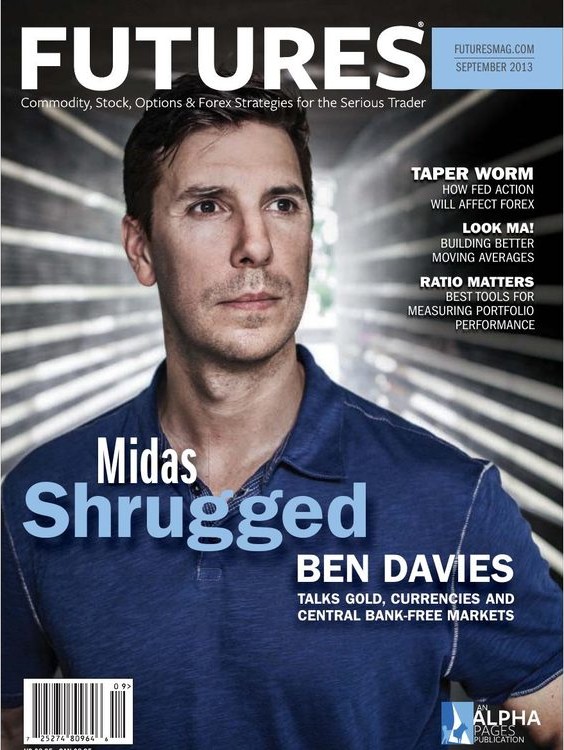 Futures · September 2013Midas ShruggedFrom athlete to trader. Money, markets and monetary reform.Read the interview →